The copier that breaks down with regularity has been granted a moniker. I have named it “Bob Marley” because it’s always jamming.

The copier that breaks down with regularity has been granted a moniker. I have named it “Bob Marley” because it’s always jamming.
Peer editing is a god-send and a nightmare, and it all depends on which peers are doing the editing. Sometimes I observe thoughtful commentary being written on student work while at other times I watch students virtually ignore what is read with no more than a “good job” written on the paper.
Thus, I have started using rounds. I know it’s not new, but it’s how I do this.
I have the students arrange desks in a large circle, and I give each student a bunch of sticky notes. The students place their own writing on the desk behind which they are standing. I am on the inside of the circle while the students are on the outside. Before we begin I hand each student a card, and each card has the specific skill or correction on which to comment. These may include a nuanced thesis, quotation usage, citation inclusion, capitalization, comma usage, pronoun/antecedent agreements, etc.
Then, I ask each student to rotate clockwise one desk, and we begin.
I begin the timer with 60 seconds. Each student gets about 45 seconds to read the piece and then has 15 seconds to write one critical comment on a sticky note and one kudos (which can be about anything read) during this time. Critiques are stuck on the desk to the left and kudos are stuck to the right. If this is a longer piece of writing, I then have the students write their names in the margin of the paper where they stopped reading, which allows a future reader to see where the editor left off.
After the 60 seconds everyone rotates, and we begin again. I usually rotate 10-15 times depending on how things are going and how long the writings are.
After 15 minutes or so, every student has a series of positive and critical comments, and each student only had one skill or correction on which to focus. This eliminates students getting overwhelmed, and, if we rotate enough times, two students may assess a piece of writing looking for the same corrections.
I monitor the process (and look for ways to improve it the next time), answer questions, keep students from chatting, and ensure everyone honors the process. Frequently, I follow the peer editing with some silent editing time where the students may use the sticky notes to mark their own papers. I can then move around the room helping students, and from time to time I allow students to partner up or talk with someone who edited his/her writing.
All in all, this has worked well for me.
While a few of my colleagues have moved to standards-based grading, I have refrained from fully moving in that direction. For one, I am not convinced we have decided on our final grade-level standards, and, for two, I am not convinced it’s the best way to go. Yes, I am not on the cusp of educational research, but no one has shown me our chosen Power Standards are all-encompassing and fully implemented.
Right now, I use GPA scoring where a 4.0 is a perfect score, a 3.0 is a B, a 2.0 is a C, and so on.
I like it.
All scores in a category are equal and all of the assignments lend equal weight. Plus, an initial poor score does not doom a student. For example, in a typical system a 100% and a 0% (a missing assignment) equals s 50% (F). In my system, the same 100% and a 0% is a 2.0 (C). After 10 assignments, both systems equal the same grade, but in the short term my system is less disastrous for a student.
I use a system very similar to Princeton’s GPA system. Let me know what you think.
I started having my students create pictures for each of their vocabulary words, and their vocabulary scores jumped immediately. Along with a few other minor tweaks and adjustments, my students–when they do what I ask–perform at a very high level when using new vocabulary words.
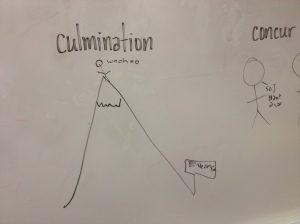
I included a picture that one of my students created for the word “culmination.” I like this drawing of the word because it simply and directly conveys the word’s meaning without any complex artistic ability needed. The students quickly present their pictures and explain how the definition matches the drawing, and the other students in the class may steal that picture or keep their own. Regardless, the students have a visual representation of the word.
 Here is another picture one of my students created for the word “dilemma.” I like this one because the student (with a sly smile) explained that she was trying to decide between finishing her vocabulary homework and her reading, and it was a dilemma since she “wanted to do them both at the same time” because they are the “most important.” This made me laugh because I joke with the kids that English is the most important and should be done first, and I enjoy it when the students joke back with me.
Non-linguistic representations are a key component of Marzano’s system of teaching students, and, when my district provided a training on Marzano’s research-based teaching strategies, I felt good about the ways I have my students work. I like routines as well, and the training reinforced my affinity for routines, so my students know which days we will practice vocabulary and when any quizzes might be given. I believe this reduces stress and allows students to feel more comfortable in the classroom.
We have a copy machine for teacher use, but it may be haunted or demon-possessed like the mangler from the film with the eponymous title. I have used it exactly 12 times this year (I usually make all of my copies during the weekend), and the copier has broken down or become massively jammed exactly 11 times.

I feel like Michael Bolton in Office Space and want to give that copier a piece of mind (and my baseball bat).
However, having said that, if this is my biggest beef at this point in the year, it’s a pretty darn good school year. 🙂
 The Doc Is In
